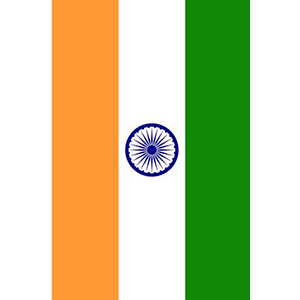
The standard sizes of the National Flag shall be as follows (Length x width in cm)

630 × 420

360 × 240

270 × 180

180 × 120

135 × 90

90 × 60

45 × 30
22.5 × 15
15 × 10
(i) the Flag shall not be used for commercial purposes in violation of the Emblem and
Names (Prevention of Improper Use) Act, 1950;
(ii) the Flag shall not be dipped in salute to any person or thing;
(iii) the Flag shall not be flown at half-mast except on occasions on which the Flag is
flown at half-mast on public buildings in accordance with the instructions issued by
the Government;
(iv) the Flag shall not be used as a drapery in any form whatsoever, including private
funerals;
(v) the Flag shall not be used as a portion of costume or uniform of any description nor
shall it be embroidered or printed upon cushions, handkerchiefs, napkins or any
dress material;
(vi) lettering of any kind shall not be put upon the Flag;
(vii) the Flag shall not be used as a receptacle for receiving, delivering, holding or
carrying anything:
Provided that there shall be no objection to keeping flower petals inside the Flag
before it is unfurled as part of celebrations on special occasions and on National
Days like the Republic Day and the Independence Day;
(viii) when used on occasions like unveiling of a statue, the Flag shall be displayed
distinctly and separately and it shall not be used as a covering for the statue or
monument;
(ix) the Flag shall not be used to cover a speaker’s desk nor shall it be draped over a
speaker’s platform;
(x) the Flag shall not be intentionally allowed to touch the ground or the floor or trail
in water;
(xi) the Flag shall not be draped over the hood, top, sides or back of a vehicle, train,
boat or an aircraft;
(xii) the Flag shall not be used as a covering for a building; and
(xiii) the Flag shall not be intentionally displayed with the “saffron” down.
2.2 A member of public, a private organization or an educational institution may hoist/
display the National Flag on all days and occasions, ceremonial or otherwise. Consistent with
the dignity and honor of the National Flag—
(i) whenever the National Flag is displayed, it should occupy the position of honor
and should be distinctly placed;
(ii) a damaged or disheveled Flag should not be displayed;
(iii) the Flag should not be flown from a single masthead simultaneously with any other
flag or flags;
(iv) the Flag should not be flown on any vehicle except in accordance with the
provisions contained in Section IX of Part III of this Code;
(v) when the Flag is displayed on a speaker’s platform, it should be flown on the
speaker’s right as he faces the audience or flat against the wall, above and behind
the speaker;
(vi) when the Flag is displayed flat and horizontal on a wall, the saffron band should be
upper most and when displayed vertically, the saffron band shall be on the right
with reference to the Flag (i.e. left to the person facing the Flag);
(vii) to the extent possible, the Flag should conform to the specifications prescribed in
Part I of this Code;
(viii) no other flag or bunting should be placed higher than or above or side by side with
the National Flag; nor should any object including flowers or garlands or emblem
be placed on or above the Flag-mast from which the Flag is flown;
(ix) the Flag should not be used as a festoon, rosette or bunting or in any other manner
for decoration;
(x) the Flag made of paper may be waved by public on occasions of important
national, cultural and sports events. However, such paper Flags should not be
discarded or thrown on the ground after the event. As far as possible, it should be
disposed of in private consistent with the dignity of the Flag;
(xi) where the Flag is displayed in open, it should, as far as possible, be flown from
sunrise to sunset, irrespective of weather conditions;
(xii) the Flag should not be displayed or fastened in any manner as may damage it; and
(xiii) when the Flag is in a damaged or soiled condition, it shall be destroyed as a whole
in private, preferably by burning or by any other method consistent with the dignity
of the Flag.
The National Flag may be hoisted in educational institutions (schools, colleges, sports
camps, scout camps, etc.) to inspire respect for the Flag. A model set of instructions for
guidance is given below:
(i) The School will assemble in open square formation with pupils forming the three
sides and the Flag-staff at the center of the fourth side. The Headmaster, the pupil
leader and the person unfurling the Flag (if other than the Headmaster) will stand
three paces behind the Flag-staff.
(ii) The pupils will fall according to classes and in squads of ten (or other number
according to strength). These squads will be arranged one behind the other. The
pupil leader of the class will stand to the right of the first row of his class and the
form master will stand three paces behind the last row of his class, towards the
middle. The classes will be arranged along the square in the order of seniority with
the seniormost class at the right end.
(iii) The distance between each row should be at least one pace (30 inches); and the
space between Form and Form should be the same.
(iv) When each Form or Class is ready, the Class leader will step forward and salute the
selected school pupil leader. As soon as all the Forms are ready, the school pupil
leader will step up to the Headmaster and salute him. The Headmaster will return
the salute. Then, the Flag will be unfurled. The School pupil leader may assist.
(v) The School pupil leader in charge of the parade (or assembly) will call the parade
to attention, just before the unfurling, and he will call them to the salute when the
Flag flies out. The parade will keep at the salute for a brief interval, and then on the
command “order”, the parade will come to the attention position.
(vi) The Flag Salutation will be followed by the National Anthem. The parade will be
kept at the attention during this part of the function.
(vii) On all occasions when the pledge is taken, the pledge will follow the National
Anthem. When taking the pledge the Assembly will stand to attention and the
Headmaster will administer the pledge ceremoniously and the Assembly will repeat
it after him.
(viii) In pledging allegiance to the National Flag, the practice to be adopted in Schools is
as follows:—
Standing with folded hands, all repeat together the following pledge:
“I pledge allegiance to the National Flag and to the Sovereign Socialist
Secular Democratic Republic for which it stands.”
3.5 Wherever the Flag is flown, it should occupy the position of honor and be distinctly
placed.
3.6 Where the practice is to fly the Flag on any public building, it shall be flown on that
building on all days including Sundays and holidays and, except as provided in this Code, it
shall be flown from sunrise to sunset irrespective of weather conditions. The Flag may be
flown on such a building at night also but this should be only on very special occasions.
3.7 The Flag shall always be hoisted briskly and lowered slowly and ceremoniously.
When the hoisting and the lowering of the Flag is accompanied by appropriate bugle calls, the
hoisting and lowering should be simultaneous with the bugle calls.
3.8 When the Flag is displayed from a staff projecting horizontally or at an angle from a
windowsill, balcony, or front of a building, the saffron band shall be at the farther end of the
staff.
3.9 When the Flag is displayed flat and horizontal on a wall, the saffron band shall be
upper most and when displayed vertically, the saffron band shall be to the right with reference
to the Flag, i.e., it may be to the left of a person facing it.
3.10 When the Flag is displayed on a speaker’s platform, it shall be flown on a staff on
the speaker’s right as he faces the audience or flat against the wall above and behind the
speaker.
3.11 When used on occasions like the unveiling of a statue, the Flag shall be displayed
distinctly and separately.
3.12 When the Flag is displayed alone on a motor car, it shall be flown from a staff,
which should be affixed firmly either on the middle front of the bonnet or to the front right
side of the car.
3.13 When the Flag is carried in a procession or a parade, it shall be either on the
marching right, i.e. the Flag’s own right, or if there is a line of other flags, in front of the
center of the line
3.14 A damaged or disheveled Flag shall not be displayed.
3.15 The Flag shall not be dipped in salute to any person or thing.
3.16 No other flag or bunting shall be placed higher than or above or, except as
hereinafter provided, side by side with the National Flag; nor shall any object including
flowers or garlands or emblem be placed on or above the Flag-mast from which the Flag is
flown.
3.17 The Flag shall not be used as a festoon, rosette or bunting or in any other manner for
decoration.
3.18 The Flag shall not be used to cover a speaker’s desk nor shall it be draped over a
speaker’s platform.
3.19 The Flag shall not be displayed with the “saffron” down.
3.20 The Flag shall not be allowed to touch the ground or the floor or trail in water.
3.21 The Flag shall not be displayed or fastened in any manner as may damage it.
3.22 The Flag shall not be used as a drapery in any form whatsoever except in State/
Military/Central Para military Forces funerals hereinafter provided.
3.23 The Flag shall not be draped over the hood, top, sides or back of a vehicle, train or
boat.
3.24 The Flag shall not be used or stored in such a manner as may damage or soil it.
3.25 When the Flag is in a damaged or soiled condition, it shall not be cast aside or
disrespectfully disposed of but shall be destroyed as a whole in private, preferably by burning
or by any other method consistent with the dignity of the Flag.
3.26 The Flag shall not be used as a covering for a building.
3.27 The Flag shall not be used as a portion of a costume or uniform of any description. It
shall not be embroidered or printed upon cushions, handkerchiefs, napkins or boxes.
3.28 Lettering of any kind shall not be put upon the Flag.
3.29 The Flag shall not be used in any form of advertisement nor shall an advertising sign
be fastened to the pole from which the Flag is flown.
3.30 The Flag shall not be used as a receptacle for receiving, delivering, holding or
carrying anything:
Provided that there shall be no objection to keeping flower petals inside the Flag before it
is unfurled, as part of celebrations on special occasions and on National Days like the
Republic Day and the Independence Day.
3.31 During the ceremony of hoisting or lowering the Flag or when the Flag is passing in
a parade or in a review, all persons present should face the Flag and stand at attention. Those
present in uniform should render the appropriate salute. When the Flag is in a moving column,
persons present will stand at attention or salute as the Flag passes them. A dignitary may take
the salute without a head dress.
3.32 When displayed in a straight line with flags of other countries, the National Flag
shall be on the extreme right; i.e. if an observer were to stand in the center of the row of the
flags facing the audience, the National Flag should be to his extreme right.
3.33 Flags of foreign countries shall proceed as from the National Flag in alphabetical
order on the basis of English versions of the names of the countries concerned. It would be
permissible in such a case to begin and also to end the row of flags with the National Flag and
also to include National Flag in the normal countrywise alphabetical order. The National Flag
shall be hoisted first and lowered last.
3.34 In case flags are to be flown in an open circle i.e., in an arc or a semi-circle, the
same procedure shall be adopted as is indicated in the preceding clause of this Section. In case
flags are to be flown in a closed, i.e., complete circle, the National Flag shall mark the
beginning of the circle and the flags of other countries should proceed in a clockwise manner
until the last flag is placed next to the National Flag. It is not necessary to use separate
National Flags to mark the beginning and the end of the circle of flags. The National Flag
shall also be included in its alphabetical order in such a closed circle.
3.35 When the National Flag is displayed against a wall with another flag from crossed
staffs, the National Flag shall be on the right i.e. the Flag’s own right, and its staff shall be in
front of the staff of the other flag.
3.36 When the United Nation’s Flag is flown along with the National Flag, it can be
displayed on either side of the National Flag. The general practice is to fly the National Flag
on the extreme right with reference to the direction which it is facing (i.e. extreme left of an
observer facing the masts flying the Flags).
3.37 When the National Flag is flown with flags of other countries, the flag masts shall be
of equal size. International usage forbids the display of the flag of one nation above that of
another nation in time of peace.
3.38 The National Flag shall not be flown from a single mast-head simultaneously with
any other flag or flags. There shall be separate mast-heads for different flags.
3.39 Normally the National Flag should be flown only on important public buildings such
as High Courts, Secretariats, Commissioners’ Offices, Collectorates, Jails and offices of the
District Boards, Municipalities and Zilla Parishads and Departmental/Public Sector
Undertakings.
3.40 In frontier areas, the National Flag may be flown on the border customs posts, check
posts, out posts and at other special places where flying of the Flag has special significance. In
addition, it may be flown on the camp sites of border patrols.
3.41 The National Flag should be flown on the official residences of the President, Vice-
President, Governors and Lieutenant Governors when they are at Headquarters and on the
building in which they stay during their visits to places outside the Headquarters. The Flag
flown on the official residence should, however, be brought down as soon as the dignitary
leaves the Headquarters and it should be re-hoisted on that building as he enters the main gate
of the building on return to the Headquarters. When the dignitary is on a visit to a place
outside the Headquarters, the Flag should be hoisted on the building in which he stays as he
enters the main gate of that building and it should be brought down as soon as he leaves that
place. However, the Flag should be flown from sunrise to sunset on such official residences,
irrespective of whether the dignitary is at Headquarters or not on the — Republic Day,
Independence Day, Mahatma Gandhi’s Birthday, National Week (6th to 13th April, in the
memory of martyrs of Jalianwala Bagh), any other particular day of national rejoicing as may
be specified by the Government of India or, in the case of a State, on the anniversary of
formation of that State.
3.42 When the President, the Vice-President or the Prime Minister visits an institution,
the National Flag may be flown by the institution as a mark of respect.
3.43 On the occasions of the visit to India by foreign dignitaries, namely, President, Vice-
President, Emperor/King or Heir Prince and the Prime Minister, the National Flag may be
flown along with the Flag of the foreign country concerned in accordance with the rules
contained in Section VII by such private institutions as are according reception to the visiting
foreign dignitaries and on such public buildings as the foreign dignitaries intend to visit on the
day of visit to the institution.
3.44 The privilege of flying the National Flag on motor cars is limited to the:—

President
Vice-President
Governors and Lieutenant Governors
Heads of Indian Missions/Posts abroad in the countries to which they are accredited
Prime Minister and other Cabinet Ministers
Ministers of State and Deputy Ministers of the Union
Chief Minister and other Cabinet Ministers of a State or Union Territory
Ministers of State and Deputy Ministers of a State or Union Territory
Speaker of the Lok Sabha
Deputy Chairman of the Rajya Sabha
Deputy Speaker of the Lok Sabha
Chairmen of Legislative Councils in States
Speakers of Legislative Assemblies in States and Union territories
Deputy Chairmen of Legislative Councils in States
Deputy Speakers of Legislative Assemblies in States and Union territories
Chief Justice of India
Judges of Supreme Court
Chief Justice of High Courts
Judges of High Courts
3.46 When a foreign dignitary travels in a car provided by Government, the National Flag
will be flown on the right side of the car and the Flag of the foreign countries will be flown on
the left side of the car.
3.47 When the President travels by special train within the country, the National Flag
should be flown from the driver’s cab on the side facing the platform of the station from
where the train departs. The Flag should be flown only when the special train is stationary or
when coming into the station where it is going to halt.
3.48 The National Flag will be flown on the aircraft carrying the President, the Vice-
President or the Prime Minister on a visit to a foreign country. Alongside the National Flag,
the Flag of the country visited should also be flown but, when the aircraft lands in countries
en route, the National Flags of the countries touched would be flown instead, as a gesture of
courtesy and goodwill.
3.49 When the President goes on tour within India, the National Flag will be displayed on
the side by which the President will embark the aircraft or disembark from it.
In the event of the death of the following dignitaries, the National Flag shall be half-masted
at the places indicated against each on the day of the death of the dignitary
| President |
Throughout India |
| Vice-President |
Throughout India |
| Prime Minister |
Throughout India |
| Speaker of the Lok Sabha |
Delhi |
| Chief Justice of India |
Delhi |
| Union Cabinet Minister |
Delhi and State Capitals |
| Minister of State of the union |
Delhi |
| Deputy Minister of the union |
Delhi |
| Governor of a state or UT |
throughout the State or UT |
| Lt. Governor of a state or UT |
throughout the State or UT |
| Chief Minister of a state or UT |
throughout the State or UT |
| Cabinet Minister of a state or UT |
Capital of the State or UT |
| |
|
3.51 If the intimation of the death of any dignitary is received in the afternoon, the Flag
shall be half-masted on the following day also at the place or places indicated above, provided
the funeral has not taken place before sunrise on that day.
3.52 On the day of the funeral of a dignitary mentioned above, the Flag shall be half-masted
at the place where the funeral takes place.
3.53 If State mourning is to be observed on the death of any dignitary, the Flag shall be
half-masted throughout the period of the mourning throughout India in the case of the Union
dignitaries and throughout the State or Union territory concerned in the case of a State or
Union territory dignitary.
3.54 Half-masting of the Flag and, where necessary, observance of State mourning on the
death of foreign dignitaries will be governed by special instructions which will issue from the
Ministry of Home Affairs in individual cases.
3.55 Notwithstanding the above provisions, in the event of a half-mast day coinciding
with the Republic Day, Independence Day, Mahatma Gandhi’s Birthday, National Week (6th
to 13th April, in the memory of martyrs of Jalianwala Bagh), any other particular day of
national rejoicing as may be specified by the Government of India or, in the case of a State, on
the anniversary of formation of that State, the Flags shall not be flown at half-mast except
over the building where the body of the deceased is lying until such time it has been removed
and that Flag shall be raised to the full-mast position after the body has been removed.
3.56 If mourning were to be observed in a parade or procession where a Flag is carried,
two streamers of black crepe shall be attached to the spear head, allowing the streamers to fall
naturally. The use of black crepe in such a manner shall be only by an order of the
Government.
3.57 When flown at half-mast, the Flag shall be hoisted to the peak for an instant, then
lowered to the half-mast position, but before lowering the Flag for the day, it shall be raised
again to the peak.
By half-mast is meant hauling down the Flag to one half the distance between the
top and the guy-line and in the absence of the guy-line, half of the staff.
3.58 On occasions of State/Military/Central Para-Military Forces funerals, the Flag shall
be draped over the bier or coffin with the saffron towards the head of the bier or coffin. The
Flag shall not be lowered into the grave or burnt in the pyre.
3.59 In the event of death of either the Head of the State or Head of the Government of a
foreign country, the Indian Mission accredited to that country may fly the National Flag at
half-mast even if that event falls on Republic Day, Independence Day, Mahatma Gandhi’s
Birthday, National Week (6th to 13th April, in the memory of martyrs of Jalianwala Bagh) or
any other particular day of national rejoicing as may be specified by the Government of India.
In the event of death of any other dignitary of that country, the National Flag should not be
flown at half-mast by the Missions except when the local practice or protocol (which should
be ascertained from the Dean of the Diplomatic Corps, where necessary) require that the
National Flag of a Foreign Mission in that country should also be flown at half-mast.